From Beverly Hills to Beijing
Documentary Notebook is a weekly newsletter for people interested in the state of the genre, people behind the camera, and the process of making documentaries.
This was the first week of Erika Girardi’s $25 million civil trial I planned to document for my film about her husband Tom Girardi and the millions in settlement funds he stole from his own clients.
Erika benefitted big time from Tom's fraud. Or so a court-appointed Trustee discovered after who poring over his financial mess.
Thus a lawsuit to recover Erika's ill-gotten gains. If you watch Real Housewives of Beverly Hills you already know all about this.
Erika settled late last week. So no trial, nothing to film.
In case you don't read People magazine, or watch TMZ, it's all there.
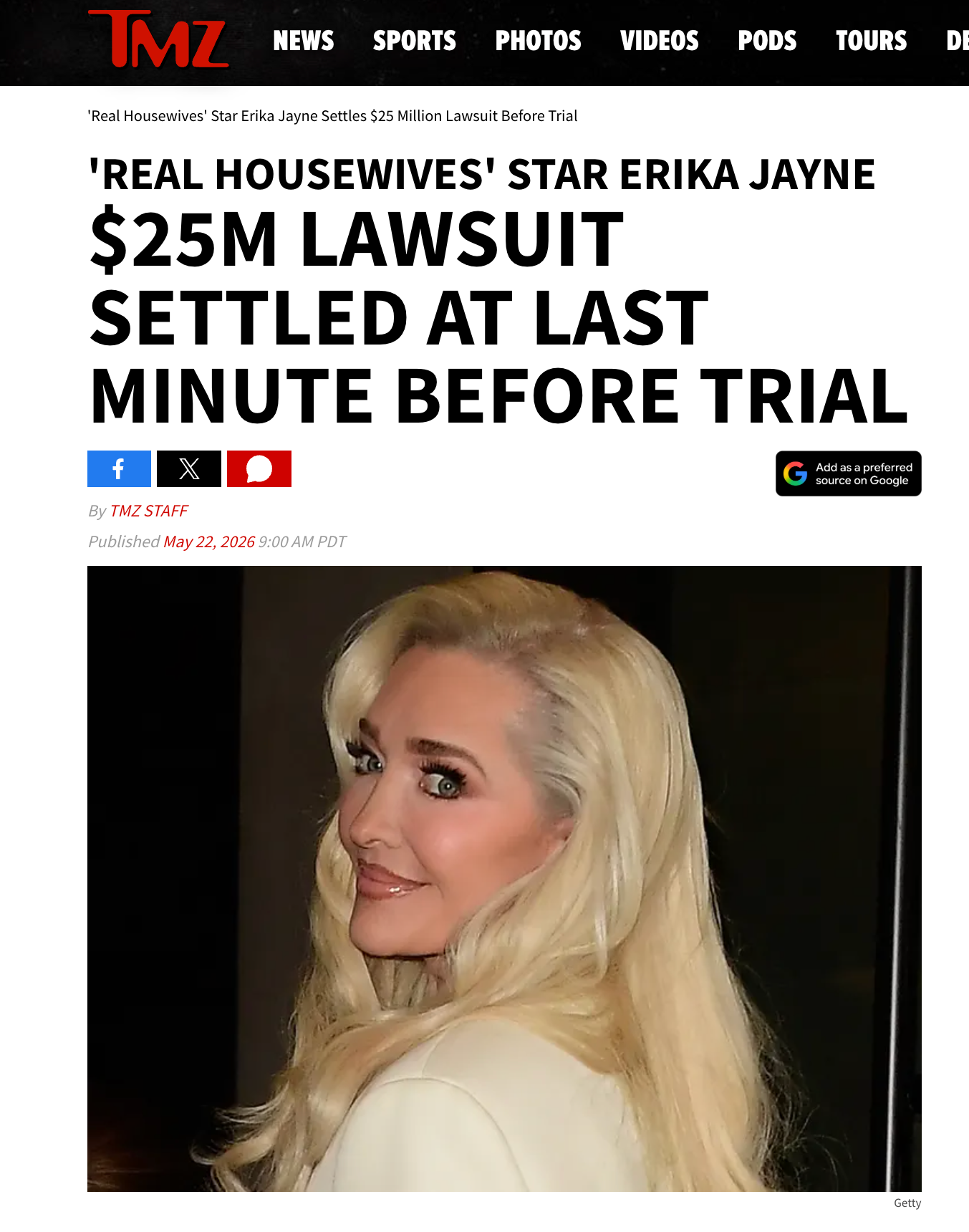
Details about the settlement amount are not public and may never be.
We do know Erika is forking over at least $2 million. That’s what opposing attorneys paid to acquire the complaint from the bankruptcy trustee — they thought it was a money-making case.
A legal professional who is a friend of the film, and appears in the film, speculated to me that Erika settled for around $3.1 million. An amount that recoups what the attorneys invested, plus some vigorish.
Erika had been making $600,000 a season on the Real Housewives show as of a couple of years ago. I know that because I have the contract.
Let’s assume she’s had a raise since then, and makes $750,00, plus or minus, per season.
She spends most of it on living expenses and her performing career, as she admitted publicly. And she has no savings, according to her attorney.
She’ll be paying off this settlement in installments for many years to come. Ten years at $300,000 per is my guess.
But wait. She’s not out of the woods yet.
Her attorney, Senor Esquire I call him, told me before she settled that she is also staring down a $4 million tax bill from the State of California.
More monthly payments.
I had planned to get an interview with Erika this week while I was there for the trial. So, what happens now?
My editor suggests she may be even more willing to go on camera given there’s no trial.
I’ll ask Esquire. But I have my doubts. If anything, by eluding the courtroom, the jury, the paparazzi, and a possible guilty verdict she may just want to put the whole sordid Girardi affair behind her.
This kind of turnaround is so common when making a documentary that it's actually a shock that documentaries ever come out as planned.
I have stories about fish that got away. I’ll tell you briefly about the one for Vice/HBO in China.
My son Walker and I were developing a documentary about cybercrime and cyber-espionage. Somehow, we landed a pitch meeting with Vice. At that time Vice was hot. They had a loyal, young audience which eluded major media companies. It was run by Shane Smith in Brooklyn.
Vice made hard-edged run-and-gun documentaries in tough places where mainstream news outlets wouldn’t go: embedded with a Kurdish women’s battalion in Iraq; hanging out with a fascist movement in Greece.
We met with a senior producer in the former warehouse that was the Vice home office in Williamsburg.
Somewhere along the line we mentioned Chinese hackers. It was a bit of a stretch, but we had some friends and sources who had friends and sources... that kind of thing.
Within a couple of weeks Vice commissioned us to produce and direct a short film about the godfather of Chinese hackers, known as The Eagle. He made his bones in the 80s, hacking western targets for the Chinese government. He'd gone straight apparently, running a cybersecurity firm. And he was willing to tell his story.
His real name: Wan Tao.
We exchanged several emails before I arrived. I finally met up with The Eagle in Beijing, at a café at a mall near my hotel. My fixer/translator was alongside. The Vice crew would fly in from the States once I had things set up.
We talked through what he might want to say. Like many hackers, he was proud of his accomplishments, and ready to share them with the world.
We agreed to meet the following day at his office across town so I could scout the location. The place was cramped with a few guys in workstations, but it could accommodate a two-camera shoot.
Here's the story about Wan Tao by Hannah Beech when she wrote for Time Magazine.
The crew flew in a day later: Rocco, the publisher of VICE magazine who would be on-camera, along with two camera guys.
Shane Smith had wanted to come to China himself and do the interview, which he would do for select projects he liked.
Before I took off for for Asia I had a conference call with Shane and the Commissioning Producer at midnight their time. (Vice was well, that kind of place. Rock 'n roll.)
Earlier I sent them a memo about security precautions we needed to take in China based on conversations I had with friends in the intelligence community and in the press: take a burner laptop, leave your mobile at home, change hotels when you arrive, and expect the worst in surveillance and monitoring.
It would be especially risky since we’d be traveling on tourist visas. Vice did not want to apply for journalism visas which could take months and still be denied.
Shane didn’t read the memo. Natch.
When I repeated the precautions, not taking our usual devices to avoid the risk of being surveilled, followed, and worse, he told me he had too many business deals in the works to not have his mobile on him at all times.
Shane stayed home.
We were driving in our van, on the way to start filming with The Eagle, when the fixer got a call on her mobile. She didn't say much and her tone was cool.
The Eagle was not going to be available to film, she told us. He was called out of town for work. He wouldn't be back in Beijing until the day we had to leave.
China had a huge internet failure that day. Maybe that was it. Or maybe his handlers decided a short film about him on HBO in the U.S. was not such a good idea.
He did show up the day we were flying out to Hong Kong. He took us out to a sumptuous banquet lunch as a consolation prize. We didn't get one frame of video.
We did film with some sources in Hong Kong about Chinese hacking while we stayed in the same hotel where Edward Snowden hid out before fleeing to Moscow. For the Vice vibes.
On returning and looking at the footage Vice decided there wasn’t enough material to make a film. It all came to naught. Not only that, the Chinese consulate called each of us saying our visas were revoked because they had discovered we were doing journalism without a license. And we'd be banned from returning.
What’s the connection between The Eagle and Erika Girardi?
Things seldom work out as planned in the world of documentaries. It’s a miracle they work out at all.
Better to plan on surprises, even failures, than to assume the best and become disillusioned.
Comments ()