Documentary, For Real?
Anthony Kaufman is a film programmer at the Chicago International Film Festival who teaches film at DePaul University in Chicago. I subscribe to his Substack newsletter.
His latest edition intrigued me, so I wanted to focus this week on his analysis. First off, he notes that Netflix released its semi-annual report on its most watched non-fiction films between January and June 2026.
Netflix is notorious about not releasing viewer information, so I was surprised to even see a list.
I was also taken aback about what’s on it.
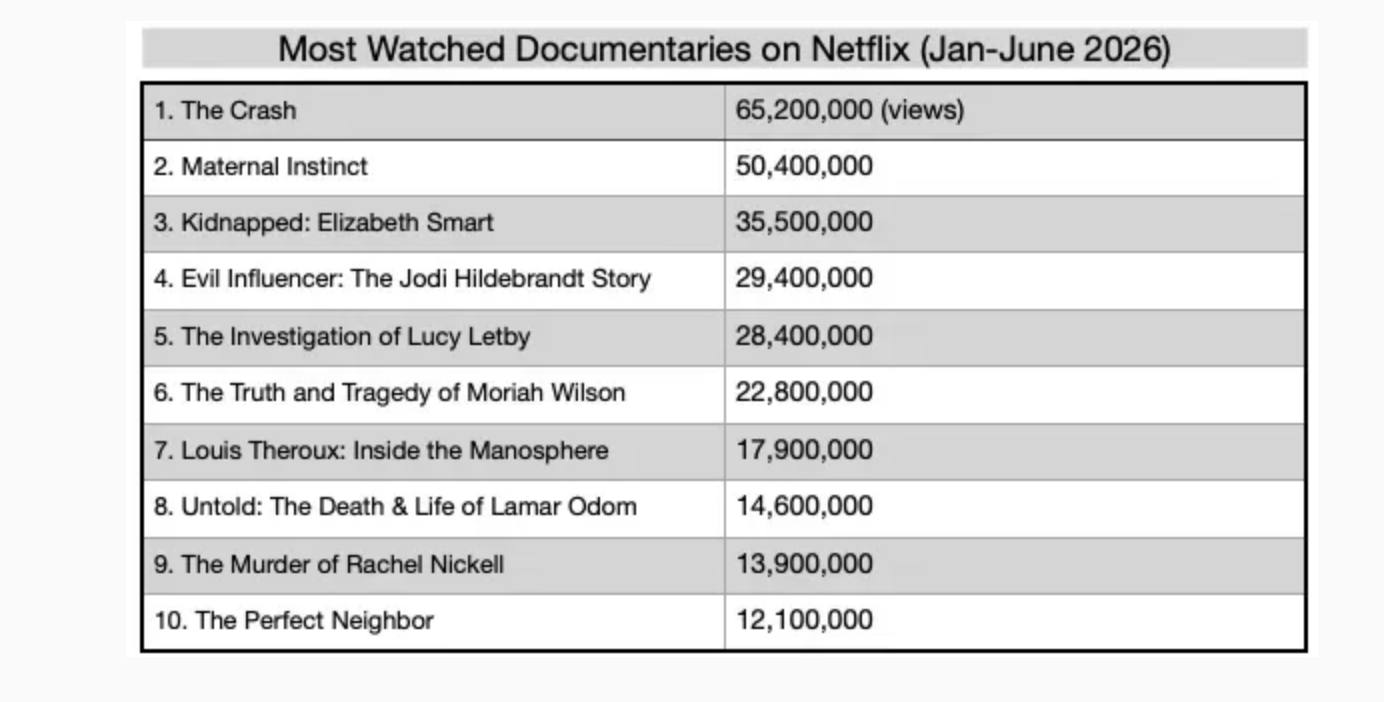
I’ve watched only one of the Netflix top ten! The Perfect Neighbor. Which I wrote about in a previous Newsletter.
I guess that says something about my Netflix viewing habits.
Kaufman goes on, having a similar take as mine on how the The Perfect Neighbor stands apart from the other nine films.
As has been the case for the last few years, the Top 10 most-watched documentary feature films are a fairly consistent, cookie-cutter grouping of familiar stories of murder, pregnant-woman murder, child murder, pop-culture phenomena (i.e. the manosphere), and coming in at #10, one anomalous independent documentary film, last year’s hit “The Perfect Neighbor.”
Netflix, like all streamers, has pre-set categories and genres for documentaries they consider for financing. Or, if it's completed, they acquire when it's done.
I’ve heard rumors they have playbooks for how their documentaries must be edited and structured. For example, at minute X there needs to be an emotional crisis for the main character; at minute Y there must be a plot twist.
Kaufman questions whether many of these non-fiction films should even be considered to be documentaries in the way most of us think about them.
I used to think the the preponderance of streamer docu-slop was kind of its own thing. Like Brett Ratner’s shiny, vomitous propaganda piece “Melania,” which is Amazon’s most watched documentary of 2026 due to its massive marketing budget, these things, as I’ve argued before, are not really documentaries.
[snip]
… this content is clearly a different type of beast than the award-winning independent documentary films that circulate at film festivals and art-houses.
The new streamer-driven, streamer-built construction is made to order for our short-attention-span multi-screen moment. And honestly, that could be fine, as long as these things existed separately.
But the problem now is that the one (docutainment) is so much more dominant over the other (documentary), in terms of resources, marketing, platforming, etc, that it continues to push the latter towards cultural extinction.
I like his terminology, “docutainment”.
Not that serious or “art-house” documentaries can’t be entertaining. Of course, they can and should be.
Rather, as he argues, when owners of the distribution channels tilt so heavily to the clicks, likes, and algorithms, we get a deck that’s stacked against films which critique society, raise difficult questions, and challenge powers that be.
I think that’s what was so repellent about Melania being called a documentary. Trump got a licensing fee and the budget was padded to enable the grift. Putting down this marker means Amazon will never carry any film critical of the Administration.
I have my own experience fighting the “docutainment” trend.
I had some nibbles when I pitched my documentary about famed plaintiffs’ attorney Tom Girardi who stole money from his clients. The story involves his wife Erika, a star of Real Housewives, who seemed to be implicated in his crimes.
A perfect two-fer: true crime and celebrity bad behavior.
I was kind of right, but also wrong.
The streamers I spoke to knew about the underlying story. After all, it’s an LA tale. That was in my favor.
But two things went against me.
More than one streamer insisted I get original footage with Tom and Erika, not just archival news footage or material from the Real Housewives show.
Tom was out of the question. Or, so I thought at the time. Stay tuned.
Erika: unlikely to talk to me. But what the heck. I tried.
Without going into detail so as not to scoop myself, Erika has not gone on camera.
Other nibblers said they appreciated the access I got, but they had too many true crime projects in the pipeline.
That old problem of supply and demand. Netflix and the others had over-stimulated the supply for true crime shows. I was late to the party.
The other “problem” with the Girardi film is it will include material which is critical of popular culture, American values, and the legal profession. That doesn't fit the bill for being docutainment.
Another documentary project is running into a similar wall: the entertainment industry's fear of Trump and political blowback.
Jon Lee Anderson of The New Yorker and I are preparing to do a documentary about technology, social media, and AI as threats to democracies and democratic movements.
We’ve been advised that anything “political” — meaning even something that's international in scope and about protecting democracy — is not going to get financed by streamers given the present climate as they perceive it.
Private sources of financing would be the only realistic means of support, our friends told us. Better to make a feature documentary, get it into festivals, and hope it gets picked up by an independent distributor, such as Magnolia, Neon, A24, or Abramorama.
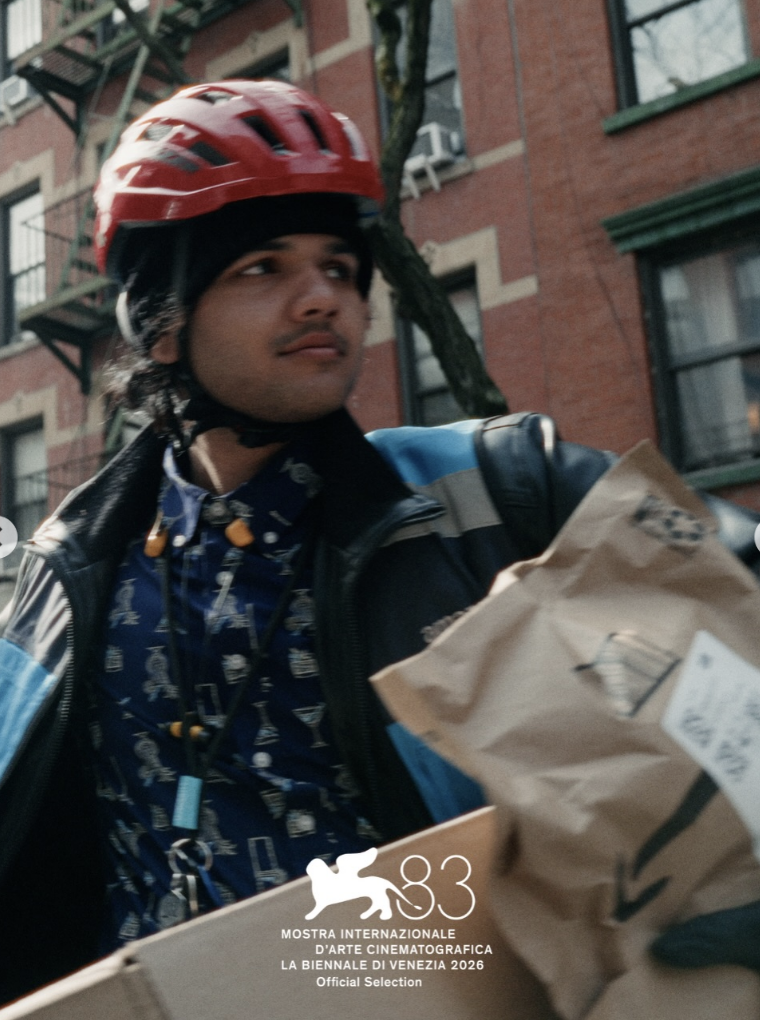
Last night I saw news that my friends Barbara Kopple and Alex Gibney will each have their new documentaries in the prestigious Venice Film Festival this September.
Barbara’s film Union Town has been in production for several years. It follows delivery industry workers in New York City, “as they take on some of the world’s most powerful corporations.”
Alex’s film Musk is about you-know-who. It's been under wraps so little is known about what kind of access Alex got to Musk (unlikely), or to those around him. It has a theatrical distribution deal with Bleecker Street.
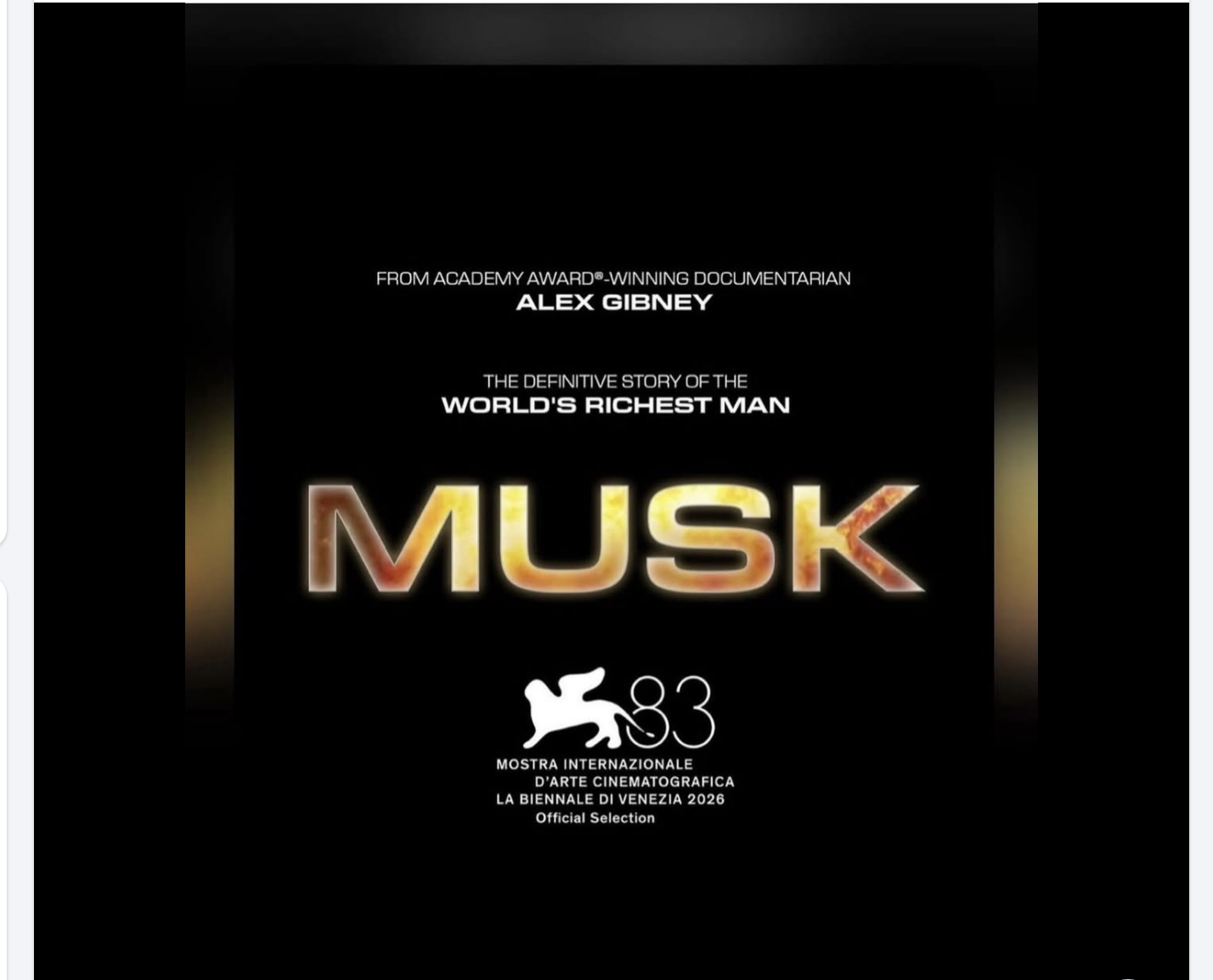
Which proves the point. For films that are “political” and take on powerful corporations, streaming is not where it’s at anymore.
Those two films would never have been greenlit by Netflix, Amazon, Apple, etc.
However, you can bet that if and when these films break through, streamers will rush in to pick them up. On the cheap.
Comments ()