Documentary About Iran and Interview with Director
Documentary Notebook is a weekly newsletter for people interested in the state of the genre, people behind the camera, and the process of making documentaries.
First off, a big thanks to all my new subscribers, many of you from Doculink, a terrific place where documentary filmmakers share information.
The documentary film Coup 53 came out in 2019. It sure is relevant now.
It tells a story covered up for decades about the overthrow in 1953 of the Iran’s democratically elected government by the CIA. Prime Minister Mohammad Mossadegh was moving ahead with nationalizing American and British oil interests. And that was a threat.
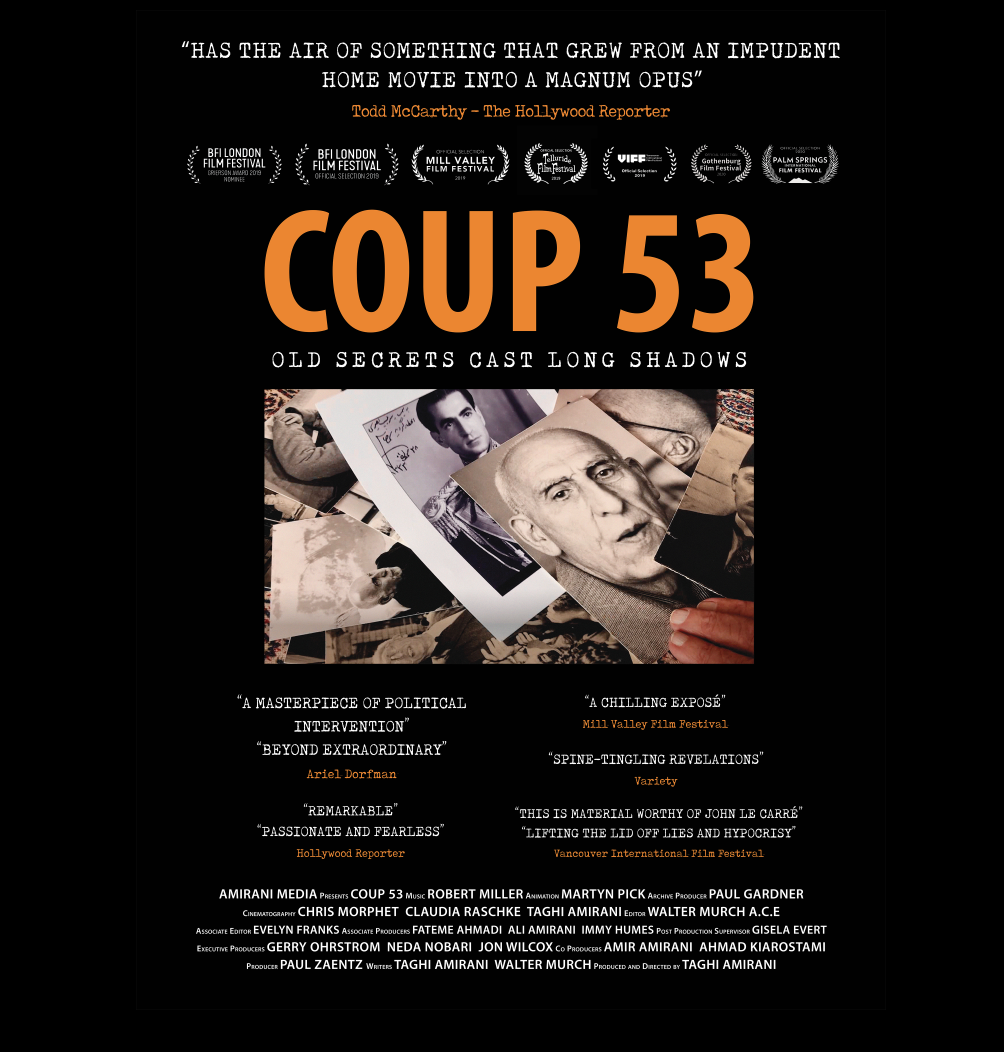
So “we” installed the Shah, Mohammad Reza Pahlavi.
Hmm. Sound familiar?
Regardless of how you feel about this War on Iran, and the attack which killed its Leader Ali Khamenei, Coup 53 places the current war in historic context.
While the film was being edited, I was fortunate to get invited to attend work-in-progress screenings in San Francisco with director Taghi Amirani and editor Walter Murch.

Subsequently, Walter was the subject of my book, Behind the Seen — the making of a major motion picture (Cold Mountain) from the film editor’s point-of-view.
Walter was deep into editing Coup 53 while he and Taghi struggled to raise finishing funds (yes, it’s a curse for all of us).
They wanted to test the rough cut with a small audience to gauge reactions and solicit comments, a crucial step as filmmakers out there know.
Watching one's film with a live audience changes perceptions. You learn where the soft spots are simply by seeing it through others’ eyes and feeling the room.
Invited guests do not hesitate to tell you exactly what they think!
Here's where you can watch the Coup 53 trailer.
One way the final film evolved from the versions I screened was by putting Taghi’s search for documentation and truth front and center, on the screen. That research usually happens off camera. Here it became the through line. A detective story.
I think it works spectacularly.
Without giving too much away, the film goes to a higher dramatic level courtesy of actor Ralph Fiennes, and that helped get the film loads of attention.
Like in this piece in the New Yorker.
"... if you are a spy, you are creating a whole persona that you have to be, for days on end,” [Fiennes] said. “It is like the supreme acting challenge. And you get no curtain call."

My Interview yesterday with Taghi via email (lightly edited)
There is so much going on now in Iran. How are you feeling?
I feel despondent and emotionally drained. Since Saturday February 28. I have been glued to the news more or less 24/7, trying to keep up with the tsunami of headlines on multiple screens.
Shock, disbelief and numbness. Sometimes I’m just pacing up and down the room, crying. I feel guilty being in London — useless and pointless as a filmmaker.
Do you have family and friends in Iran? If so, what are you hearing?
I have many relatives and friends in Iran. Communication is disrupted. When we do make contact, we have brief conversations about their safety and well-being. There is no time for any nuanced political analysis. None is needed. We all know.
For me Coup 53 vibrates in a new, urgent, and powerful way. Do you sense this?
Yes, all the time.
I have had a Google News alert for “Coup 53” and “Mossadegh” for at least five years. Now I am getting notifications every day.
Every mature analysis and thoughtful essay mentions 1953.
As someone who is immersed in this history, what’s your take on the role of the U.S. now, compared to 1953? Same dynamic writ large, or something different?
Same dynamic without the mask, aided by AI technology doing targeting and killing, by cyber warfare, and millions spent on social media influencers and bots.
I have been downloading and archiving thousands of posts. A clear pattern emerges of regime change on steroids.
I would hope the film is getting increased interest and attention. Are you seeing that?
Yes, a huge spike. We are now looking into a theatrical re-release. The time for the film has come.
Requests for public screenings and university educational licenses have spiked. The latest came from as far as New Zealand. Before that Germany and Italy.
This newsletter is aimed at documentary filmmakers and their audiences. What would you like to convey to them about the film and events underway now?
Watch and learn about history and context.
Iran had a democracy in 1953. Its destruction by the U.S. and the UK led to the 1979 revolution which has brought us to this point — the precipice of catastrophe for Iran and the world.
It breaks my heart. These are dark days that will get darker.
Where to see it:
The film website includes links to stream.
This coming Sunday March 8, Coup 53 will be screening at the Hindsight Film Festival. Walter and Taghi are doing a live Q&A on Zoom.
For more background:
As CNN reported, it took 60 years, but ultimately the CIA came clean about its role.
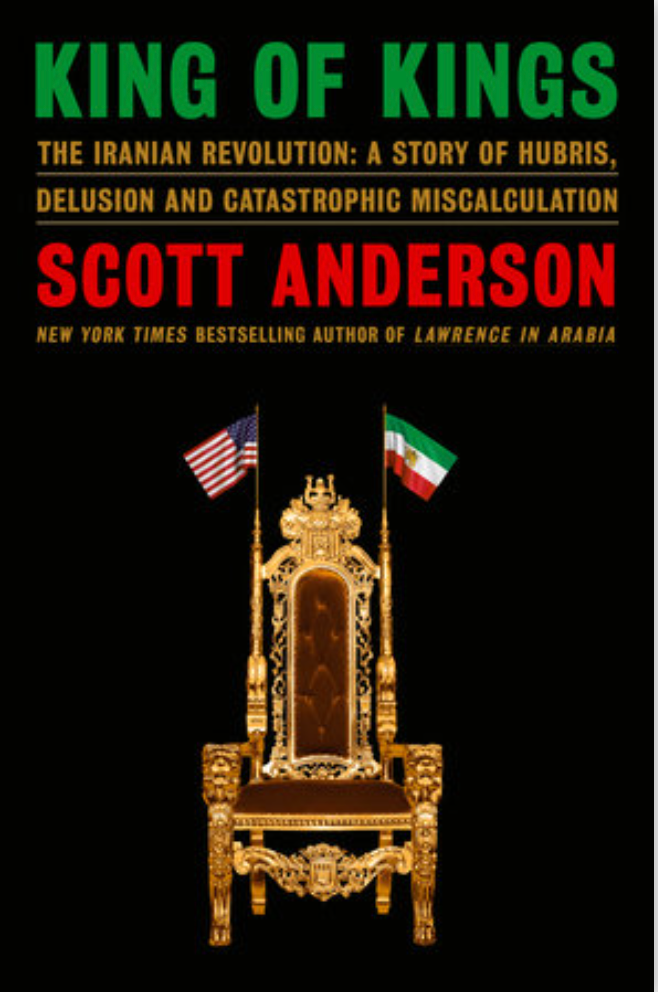
For a highly readable account of the rise and fall of Iran under the Shah, you won’t do better than King of Kings, written by Scott Anderson. By coincidence (or not!) he's the brother of Jon Lee Anderson, with whom I am making Discord Democracy, the feature documentary I described in previous newsletters.
Walter Murch likes to say, “Aim for a B”. That's a good grade. You made the best film you could. If you rose to the top, had a big hit, and got an “A” — it was up to the gods. Time and circumstances do the final work to lift a film.
Events unfolding in Iran are uncertain and difficult, with powerful consequences we cannot yet know.
As Taghi told me, in a time like this, he feels, “…useless and pointless as a filmmaker.”
I think all filmmakers feel that way at one moment or another. Our work is tangible, yet the impact is often amorphous and impossible to pin down.
It looks like Coup 53 will now find a rightfully larger audience, and the recognition it deserves.
And that is something positive.
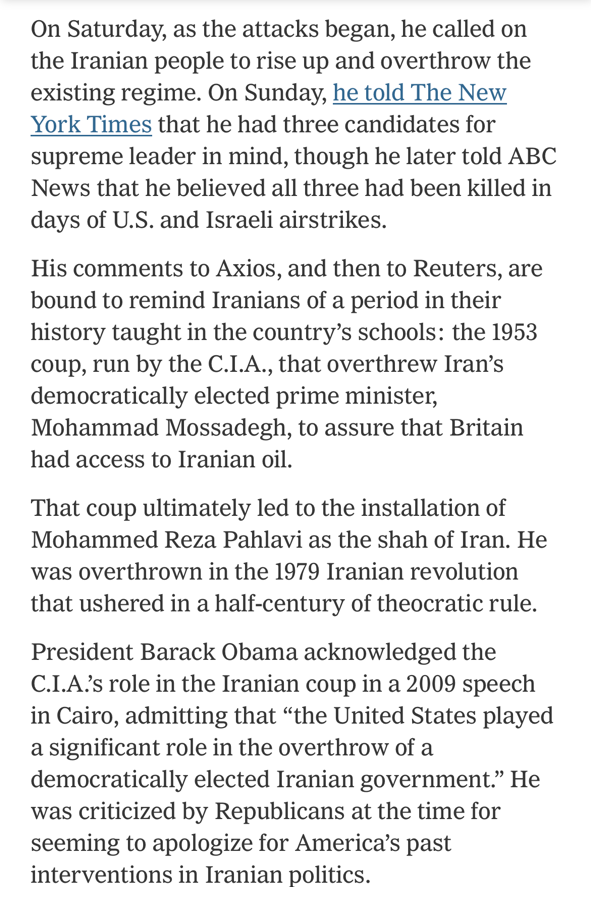
Update Thursday 3:30p PST: The New York Times just posted a reference to the 1953 coup specifically in relation to Trump replacing Khamenei in Iran.
If you are enjoying Documentary Notebook, please share with friends and colleagues, and encourage them to subscribe. Big thanks.
Comments ()